

What Is the Job of a Virtual Assistant in a Coaching Business?

Updated: 5 days ago

If you run a coaching business, you already know how many moving parts exist behind the scenes.
You’re not just coaching.
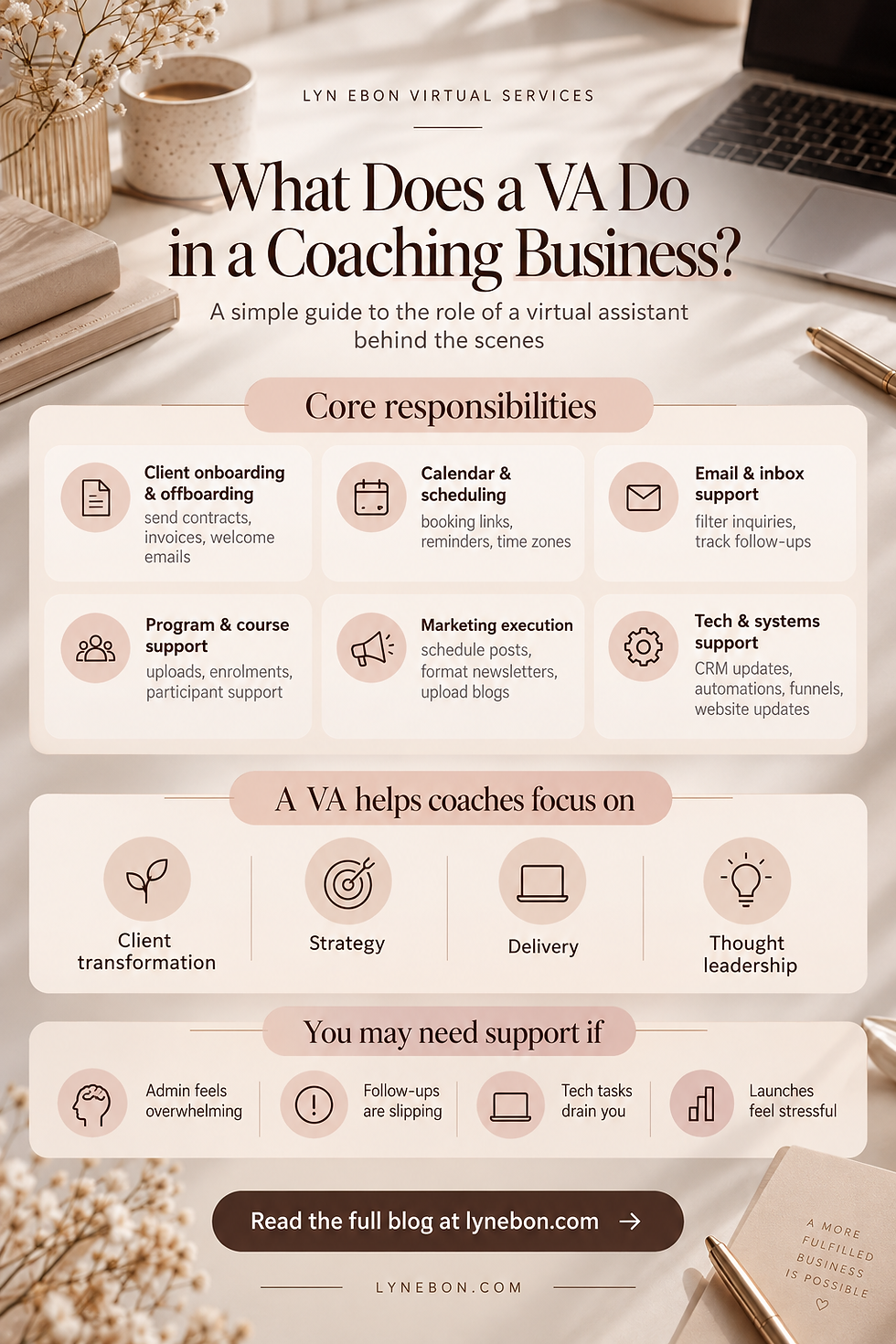
You’re:
Marketing
Scheduling
Following up
Managing payments
Sending contracts
Uploading resources
Handling tech
Responding to emails
At some point, it becomes unsustainable.
So what exactly is the job of a virtual assistant in a coaching business?
Let’s break it down clearly.
A Virtual Assistant Protects the Coach’s Focus
In a coaching business, your highest value is:
Client transformation
Thought leadership
Strategy
Delivery
A virtual assistant handles the operational layer so you can stay in your zone of genius.
The job is not to replace you.
The job is to protect your capacity.
Core Responsibilities of a Virtual Assistant in a Coaching Business
Not all VAs support coaches in the same way, but here are the most common areas.
1. Client Onboarding & Offboarding
This is one of the most important backend functions.
A virtual assistant may:
Send contracts and agreements
Issue invoices
Set up payment plans
Add clients to programs or platforms
Send welcome emails
Provide onboarding documents
Smooth onboarding sets the tone for professionalism.
When this process is organised, clients feel safe and supported from day one.
2. Calendar & Scheduling Management
Coaches often juggle:
Discovery calls
Client sessions
Group programs
Workshops
Masterclasses
A virtual assistant can:
Manage your calendar
Set up booking links
Send reminders
Avoid double bookings
Adjust time zones
This reduces constant back-and-forth emails.

3. Email & Inbox Support
Coaches receive a high volume of messages.
A VA may:
Filter inquiries
Flag priority emails
Draft responses
Organise folders
Track follow-ups
An organised inbox helps prevent missed opportunities.
4. Program & Course Support
If you run online programs, your virtual assistant may:
Upload lessons
Schedule modules
Manage enrolments
Send reminders
Handle participant questions
Troubleshoot minor tech issues
This ensures the delivery side runs smoothly.
5. Marketing Execution
Many coaches hire virtual assistant services for marketing support.
This may include:
Scheduling social media posts
Formatting newsletters
Uploading blogs
Repurposing content
Basic graphic design
Tracking analytics
Important distinction:
Most VAs implement marketing.
They do not necessarily build full strategy unless positioned for it.
6. Tech & Systems Support
Behind every coaching business is tech.
A virtual assistant may manage:
CRM updates
Email automation
Landing page uploads
Funnel setup
Website updates
Client portals
Tech issues create stress quickly.
Structured support prevents that stress from landing on you.
Beyond Tasks: Operational Stability
In more established coaching businesses, the role can expand.
Instead of just task execution, a VA may:
Coordinate contractors
Track project timelines
Maintain workflows
Identify bottlenecks
Run monthly planning calls
Ensure deadlines are met
This shifts the role from assistant to backend operations support.
For growing coaches, this level of support often becomes essential.
What a Virtual Assistant in a Coaching Business Does Not Do
It’s important to clarify boundaries.
Most professional VAs do not handle:
Direct sales conversations
High-pressure DM closing
Commission-based selling
Cold outreach
Their role is operational and execution-based.
Coaches remain responsible for sales conversations and delivery.
Clear boundaries prevent misunderstandings.
When Does a Coaching Business Need a Virtual Assistant?
You may need support if:
You’re overwhelmed with admin
You’re missing follow-ups
You feel behind on content
Tech tasks drain you
Your inbox is chaotic
Launches feel stressful
You’re doing everything yourself
Support is not a luxury.
It’s infrastructure.
The Real Job of a Virtual Assistant in a Coaching Business
The real job is this:
To ensure everything behind the scenes runs smoothly so the coach can focus on impact.
When backend operations are stable:
Clients feel supported
Delivery improves
Revenue becomes more predictable
Growth feels sustainable
Support should reduce mental load, not add to it.
If You’re Exploring Support for Your Coaching Business
If you’re running a coaching business and wondering whether you need admin-level help or structured backend operations support, clarity matters before hiring.
I oversee backend operations across marketing, admin, and tech to ensure coaching businesses run smoothly behind the scenes.
No pressure. Just structure and alignment.
About Lyn Ebon
Lyn Ebon provides high-level, strategic virtual assistant support designed to help coaches and solo business owners operate with more clarity, organisation, and consistency.
Her work covers backend operations, social media visibility, content and marketing systems, client and program management, and funnel setup and optimisation. She focuses on bringing structure and steady execution behind the scenes so business owners can focus on their expertise while their business runs smoothly.
Learn more at www.lynebon.com.


Comments